The Coming Age of Digital Twins: Rethinking Medicine, Treatment, and Human Longevity

Healthcare is approaching a profound transformation. For centuries, medicine has largely operated by observing diseases after they appear and then attempting to treat it. Even with modern diagnostics and advanced pharmaceuticals, most treatments are still based on averages drawn from large populations rather than on the precise biology of an individual patient. A new technological concept known as the digital twin may fundamentally change this paradigm. By creating dynamic virtual replicas of human bodies, digital twins promise to move medicine toward a future that is predictive, personalized, and potentially capable of extending healthy human life.
The concept of digital twins did not originate in medicine. It emerged in engineering and industrial systems, where companies built digital replicas of machines, factories, and infrastructure to monitor performance and predict failures. By simulating how equipment behaves under different conditions, engineers could anticipate problems before they occur and optimize operations. In recent years, advances in artificial intelligence, data analytics, and computational modeling have made it possible to apply this idea to biology. Instead of modeling engines or turbines, scientists are now beginning to model the human body itself.
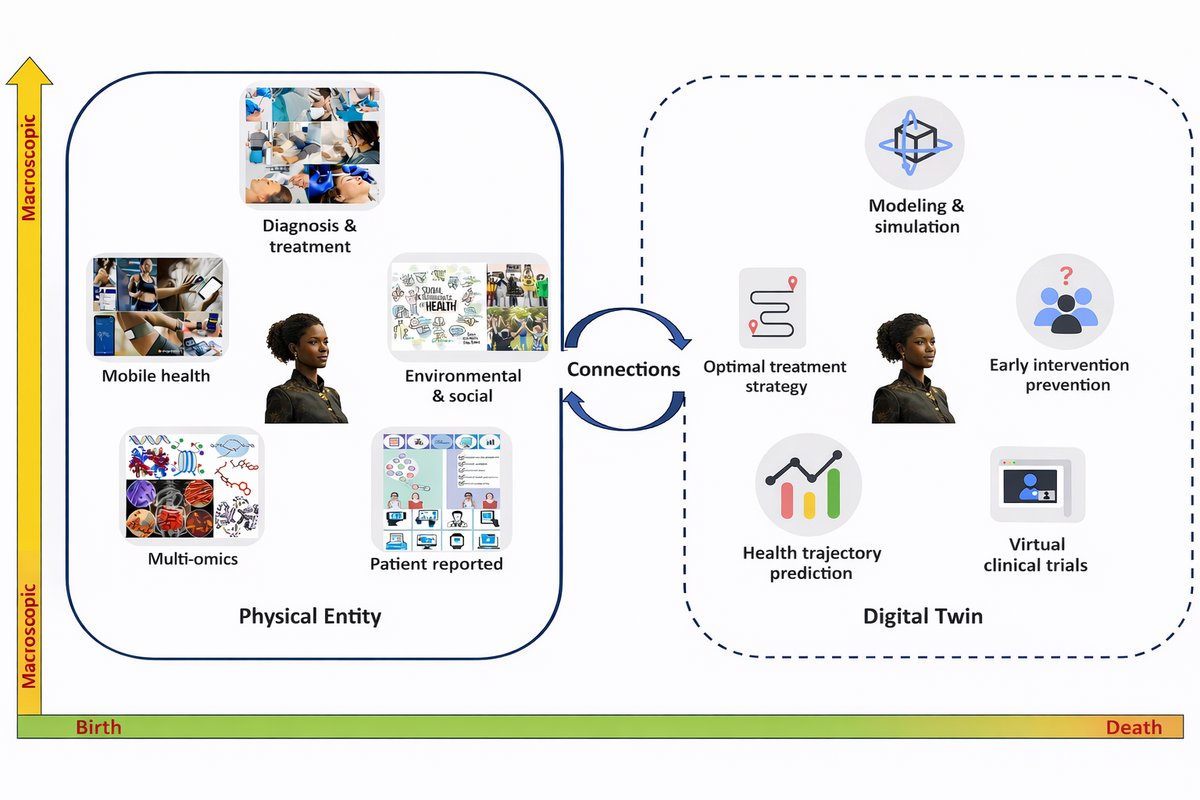
A digital twin in healthcare is essentially a living computational model of a person. It is constructed using large amounts of biological and behavioural data collected from multiple sources. These may include genomic sequencing, medical imaging, laboratory results, electronic health records, and increasingly, continuous streams of data from wearable devices and biosensors. The goal is to create a dynamic digital representation that mirrors how a person's body functions in real time. As new data is collected, the model updates and evolves, gradually becoming a more accurate reflection of that individual’s health.
What makes digital twins truly powerful is not just their ability to represent the body, but their ability to simulate it. With sufficient data and sophisticated modeling tools, researchers can run virtual experiments on the digital twin before applying treatments to the real patient. Doctors could test how different drugs interact with a patient’s metabolism, simulate the impact of surgical interventions, or explore how lifestyle changes might influence disease progression. In effect, digital twins allow medicine to move from guesswork toward evidence generated specifically for each individual.
This capability has profound implications for personalized medicine. For decades, clinicians have recognized that patients respond differently to treatments, yet healthcare systems have struggled to account for these differences in a practical way. Digital twins offer a mechanism for doing exactly that. By modeling the biological complexity of an individual, physicians may be able to identify the most effective therapies with far greater precision. Rather than relying on trial and error, treatments could be optimized in advance through simulation.
Digital twins also have the potential to transform surgical planning and clinical decision-making. Surgeons already rely heavily on imaging technologies to understand patient anatomy, but a digital twin goes much further. Imagine a surgeon practicing a complex procedure on a fully simulated version of a patient’s heart or brain before entering the operating theatre. Potential complications could be explored and mitigated in advance, reducing risks and improving outcomes. This approach could usher in a new era of precision surgery where every intervention is informed by detailed simulation.
Beyond treatment, digital twins could play a critical role in managing chronic disease, which remains one of the greatest challenges facing global healthcare systems. Conditions such as cardiovascular disease, diabetes, and cancer often develop gradually and involve complex biological interactions. A digital twin can model how these conditions evolve over time within a particular individual. By continuously updating the model with new data, clinicians could detect subtle changes long before they manifest as symptoms. This creates an opportunity for early intervention that could prevent serious health events altogether.
Another area where digital twins may have significant impact is drug development. Bringing a new medication to market can take more than a decade and cost billions of dollars. Much of this expense arises from the difficulty of predicting how drugs will behave in diverse populations. Digital twins could allow researchers to simulate drug interactions in virtual populations before conducting large-scale clinical trials. This approach may help identify promising therapies faster while reducing risks to human participants.
Perhaps the most transformative potential of digital twins lies in their ability to shift medicine toward prevention rather than reaction. Today, healthcare systems often intervene only once disease has become visible through symptoms or diagnostic tests. Digital twins could enable a much earlier understanding of biological risk. By analyzing patterns within complex datasets, digital models may detect warning signs of disease years before conventional diagnostics would reveal them. This capability could fundamentally reshape healthcare by enabling interventions that maintain health rather than simply treating illness.
The implications extend even further when we consider the challenge of human aging. Aging is not a single process but a complex web of biological changes involving genetics, metabolism, cellular damage, immune function, and environmental influences. Understanding how these processes interact has been one of the most difficult problems in biomedical science. Digital twins may provide a new lens through which researchers can study aging by simulating how biological systems change over time within an individual.
In the long term, this could open the door to personalized longevity strategies. Each person ages differently, influenced by their genes, lifestyle, environment, and health history. A digital twin could simulate how various interventions from diet and exercise to emerging therapies affect an individual's aging trajectory. Rather than relying on generalized advice about healthy living, individuals could receive recommendations tailored specifically to their biological profile. The result could be not only longer lifespans but longer periods of healthy, productive life.
However, as with any transformative technology, digital twins also raise important challenges. The creation of accurate digital representations of human biology requires vast amounts of sensitive health data. Ensuring privacy and protecting individuals from misuse of this information will be essential. Ethical questions will also arise around ownership of digital biological models and the potential use of predictive health data by insurers, employers, or governments.
There are also technical challenges to overcome. The human body is one of the most complex systems known to science, and creating fully accurate digital representations remains a formidable task. While significant progress has been made in modeling individual organs and physiological processes, building a comprehensive digital twin of the entire human body will require advances in computational power, biological understanding, and data integration.
Yet the direction of progress is unmistakable. Advances in artificial intelligence, genomics, biomedical engineering, and sensor technologies are rapidly expanding our ability to collect and analyze biological data. As these fields converge, the vision of digital twins in healthcare is moving from theoretical possibility to practical reality.
In the coming decades, digital twins may become a central pillar of medicine. Hospitals may routinely create digital models of patients to guide treatment decisions. Researchers may use virtual populations to accelerate scientific discovery. Individuals may even maintain personal digital twins that monitor their health continuously and help them make informed choices about their well-being.
If that future unfolds, medicine will undergo a fundamental shift. Healthcare will no longer focus primarily on treating disease after it appears. Instead, it will increasingly aim to understand, predict, and optimize the biological systems that sustain life. In that sense, digital twins represent more than a technological tool. They represent a new philosophy of medicine, one that seeks not only to cure illness but to extend the boundaries of healthy human life.